

In short
The pull force shown on a fishing magnet’s packaging is measured under ideal conditions: perpendicular to a clean, flat metal plate 0.4 in (1 cm) thick. In practice, you often get less grip because rust, silt, or a curved object reduces contact. Starting out as an adult? The Hardcore fishing magnet, with 1,300 lb (600 kg) of pull force, is a powerful allround choice. For children, the Easy fishing magnet with 600 lb (280 kg) is a beginner option.
How strong should your fishing magnet be, and how much pull force do you actually need for magnet fishing? There is no single answer. It depends on what you want to find, your experience, and where you plan to fish. In this article, we explain how pull force is measured, why it is often lower in real conditions, and which fishing magnet best suits your situation.
Want to know which option fits you right away? Select your magnet fishing experience level below for a recommendation.
Kids
Kids Package 250 lb (110 kg) for young children and Kids Package 360°, 600 lb (280 kg) for children ages 7 and up with adult supervision.
Why? These magnets are lightweight and manageable. The kits include what you need to get started right away. They also make a fun gift for kids!
Beginning magnet fisher
The Hardcore with 1,300 lb (600 kg) of pull force, also available in the complete Pro Package or Girl Power kit.
Why? A 360° attraction range and a solid allround choice. Strong value for the money.
The Beast X, 3,100 lb (1,400 kg), for beginners who know they want to keep magnet fishing and have the strength to handle a heavier magnet.
Why? Its 360° magnetic field also makes it interesting for experienced magnet fishers. Fully assembled and packed in a MagShield™ bag for safer transport and convenience.
Experienced magnet fisher
The Beast fishing magnet with 3,100 lb (1,400 kg) of pull force, included in the Legend Package. Or the Barbarian fishing magnet with 3,500 lb (1,600 kg), included in the Savage Package.
Note: The Beast fishing magnet weighs 4.7 lb (2,130 g) and the Barbarian weighs 5.9 lb (2,662 g). Repeated casts can feel heavy for some people. Concerned about that? As an experienced magnet fisher, consider the Terror or Beast X.
Maximum catching potential
Want the best possible catching potential and a well-protected fishing magnet? Consider the CUBE with 3,000 lb (1,350 kg) of pull force or the MEGACUBE with 6,000 lb (2,700 kg).
Why? Six magnetic sides and a very large magnetic field. A steel housing helps protect against impacts. Both arrive as complete, fully assembled kits in a MagShield™ case for safer transport and convenient use.
Lower budget
Not ready to pay top dollar for a fishing magnet? Take a look at our Classic single-sided fishing magnets.
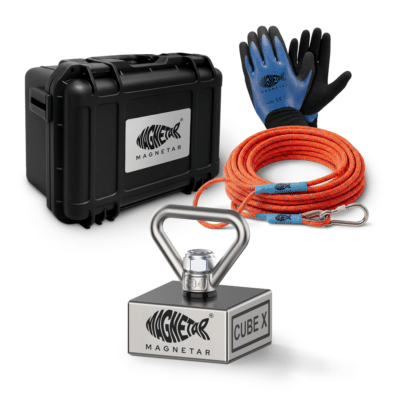
Want stronger catching potential without spending the maximum? Check out our X Line fishing magnets, such as the CUBE X or MEGACUBE X.
The Pro Package also offers strong value for the money.
How Do Manufacturers Measure a Fishing Magnet's Pull Force?
A fishing magnet’s pull force is measured under ideal laboratory conditions: pulling perpendicular to a clean, flat steel plate 0.4 in (1 cm) thick. As soon as you pull at an angle, the effective force drops. Rust, leaves, or other debris between the magnet and the metal also reduce it, as does a curved surface. So when the packaging says 1,300 lb (600 kg), that number applies to those specific test conditions. It does not automatically apply underwater.
Why Is a Fishing Magnet Weaker in Practice Than the Packaging Suggests?
Magnet fishing takes place in water, not on a clean test plate. On the way up, your magnet often encounters silt, leaves, and rust, all of which reduce its grip. Still, a fishing magnet rated at 770 lb (350 kg) generally handles heavier objects better than one rated at 330 lb (150 kg).
Round or curved objects are particularly difficult. A helmet, for example, is curved and can be only about 0.12 in (0.3 cm) thick, which sharply reduces the available pulling force. A bicycle presents the same problem: the magnet cannot sit flat against a thin, round frame tube about 1.2 in (30 mm) in diameter. In the example from the original article, a 550 lb (250 kg) magnet grips such a tube with only about 66 to 77 lb (30 to 35 kg) of force, just enough to free the bicycle. Safes may be easier to retrieve because they have flat surfaces and are often less rusty.
Why Does an Allround Fishing Magnet Catch More Than a Single-Sided Magnet?
Want to depend less on the shape of an object? Choose an allround fishing magnet. An allround magnet attracts metal from every side, producing a 360° magnetic field. This improves contact with curved or round objects and creates a wider magnetic catching area. It can attract objects from more directions than a single-sided (Classic) fishing magnet, which pulls from only one side.
How Much Pull Force Do You Need for Your Situation?
Are you an adult starting magnet fishing and looking for good value? Choose the Hardcore fishing magnet (1,300 lb / 600 kg, allround). It is a strong option for discovering what is hiding underwater.
Is your child getting started? The Kids Package 250 lb (110 kg) is designed for younger children, and the Kids Package 360°, 600 lb (280 kg) is for children ages 7 and up with adult supervision.
Would you rather spend a little less and accept pulling force on only one side? Browse our single-sided (Classic) fishing magnets.
Want a better chance of retrieving larger, heavier objects such as safes? Choose a powerful fishing magnet from our allround range or a block magnet. Both types offer a broad attraction range: the farther away a magnet can attract metal, the greater your chances of making a find.
-
Rated 5.00 out of 5Add to cart
$ 94.99Original price was: $ 94.99.$ 84.99Current price is: $ 84.99. -
Rated 4.73 out of 5Add to cart
$ 54.99Original price was: $ 54.99.$ 44.99Current price is: $ 44.99. -
-
Rated 4.88 out of 5Add to cart
$ 164.99Original price was: $ 164.99.$ 124.99Current price is: $ 124.99.


What Should You Do if Your Fishing Magnet Gets Stuck?
Is your fishing magnet stuck firmly to steel sheet piling or a heavy piece of iron? Insert a long metal bar through the eye of the magnet and use leverage to break the magnetic hold. You can also try a strong pull at an angle or pull from a different direction than the one you lowered it from. For a detailed step-by-step approach, including what to do if these methods fail, see our article Your Fishing Magnet Is Stuck: How to Release It.
This video visually compares a 150 kg Magnetar neodymium magnet with a cheap 600 kg Amazon magnet to test real-world magnetic field strength. Despite the lower advertised weight limit, the Magnetar magnet attracts significantly more coins at once and crushes objects much more forcefully due to its concentrated magnetic flux density. The visual demonstration proves that advertised pull force numbers on cheap packaging do not always reflect actual performance.
This video warns magnet fishers against buying magnets based solely on high pulling force advertised on the packaging. It explains that real catching power depends on four key factors: the material, shape, diameter, and overall magnet type. Understanding these parameters ensures you select a magnet that actually performs well underwater.
This video uses a striking analogy to explain how cheap magnet manufacturers cut neodymium powder with low-quality filler substances, similar to how illegal substances are diluted. It demonstrates that cheap magnets with high weight claims often underperform in real-world conditions compared to premium, high-purity neodymium magnets. Ultimately, using high-quality materials ensures a stronger magnetic field and significantly better catches while magnet fishing.
Conclusion
The pulling-force rating on fishing magnet packaging is a laboratory measurement, not a guarantee of how much you can lift out of the water. Rust, silt, and an object’s shape all affect the force available in practice. Instead of choosing only the highest number of pounds, consider an allround fishing magnet that can also grip curved or round objects. For most beginners, the Hardcore fishing magnet is an excellent starting point.
Still unsure which model fits you? Explore our full fishing magnet range.
Frequently asked questions
How Much Pull Force Do You Need for Magnet Fishing?
For beginners, an allround fishing magnet rated between 600 and 1,300 lb (280 to 600 kg), such as the Easy or Hardcore, is often sufficient. For heavier or more deeply buried objects such as safes, a stronger allround or block magnet can be a better choice. Don’t choose by the maximum pull-force figure alone; consider how well the magnet can grip curved or round objects.
Why Is My Fishing Magnet Weaker in Water Than Its Rated Pull Force?
The stated pull force is measured while pulling perpendicular to a clean, flat steel plate 0.4 in (1 cm) thick. Underwater, rust, silt, and an angled pull lower the force you can actually use. Curved objects such as bicycles and helmets reduce it further because the magnet cannot make full flat contact.
What's the Difference Between Single-Sided and Allround Fishing Magnets?
A single-sided (Classic) fishing magnet pulls on only one side. An allround fishing magnet attracts metal from every side and therefore has a 360° magnetic field. This gives better contact with curved objects and a wider search area, improving the chance of a catch.
Which Fishing Magnet Is Best for Beginners?
For adult beginners, the Hardcore fishing magnet (1,300 lb / 600 kg, allround) is a powerful option with good value for the money. For children, the Easy fishing magnet (600 lb / 280 kg, allround) is an accessible starting model to use with adult supervision.
What Should I Do if My Fishing Magnet Gets Stuck Underwater?
Insert a long metal bar through the magnet’s eye and use leverage to break the magnetic hold. If that fails, try pulling firmly at an angle or from another direction. For more detailed guidance, see our article about freeing a stuck fishing magnet.